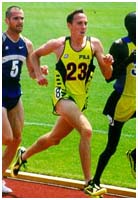
In a candid discussion about his running, Canadian Master athlete, Steve Boyd puts a different slant on his attitude towards his running and what makes it still special.
When I was still in my prime as an open runner, I always imagined I’d give up racing when I reached my late 30s and maybe revisit some of the sporting hobbies of my youth; I thought perhaps I’d join an “old-timers” hockey league, or maybe get more seriously into weight lifting.
That hasn’t happened, I’m somewhat perplexed to report. Here I am 41 years old and still toeing the line in road and cross-country events across the continent! I once joked, that if there was a pill I could take to make me stop caring about running; to somehow purge from my system the desire to train hard and compete, I’d might consider taking it.
Not having the itch to train and race anymore would certainly make life easier in some respects. There’s no such drug, of course (even alcohol is useless here, believe me!), but I’m still wondering if there’s a way to quietly and safely turn off the desire to train and race, the way some athletes seem to have been able to do. An uncommon determination to work hard and improve is requirement for success in a sport like distance running in the first place, but what does one do when the fixation on performance that’s so necessary in the beginning runs up against the realities of the aging process? How does an old runner let go?
Or IS it necessary to let go after all? It’s taken a couple of years of reconciliation, and some inspiration from the many recreational age-class performers I’ve met, some of whom I now coach, but I’ve decided that’s it’s possible to start anew at 40. After the slow decline of my late 30s and a couple of seasons of masters competition, I’ve come to realize that it wasn’t really the quest for personal bests that kept me involved in competitive running, but simply the daily communion with my body, the struggle for mental and emotional mastery that racing and training entail, and, as one ex-elite master runner put it, simply “the feeling that I could still do something well”, even if not quite as well as when I was younger.
So, while I now have to fit training in around the demands of making ends meet and being a parent to my school-age children, I still manage to do the work necessary to satisfy my old appetite for the struggle. I have to be smarter about how often and how hard I run, since ageing makes good performance a constantly moving target; but luckily, intelligence, unlike flexibility or strength, is something that improves with age (or should anyway)! And it’s certainly helped that master’s running is bigger than ever in North America (and likely set to get bigger still, driven by simple demographics), with many top level competitions in track, cross country and road racing, including prize money events to spice things up. I can’t say how much longer I’ll want to go on, but, if personal history is any guide, likely much longer than I imagine. I’d like to say I won’t be chasing any of “Uber-Master” Ed Whitlock’s age 70+ records, but who knows. On the other hand, maybe before I get there they’ll have perfected that drug…
What brought you to running and in what year?
I ran my first race in the 6 th grade, which was in 1975, I think. I got into distance running because I wanted to be on the school track team and the only event I could make it in that year was the 800m (only one other guy tried out!). The year later, I made the team in the 800, 1500 and high jump, which I was quite good at. To this day, I’m sure I’m the only kid in this area, and maybe any area, to win school board championships in these three events.
Were you a stand out performer at High School and College?
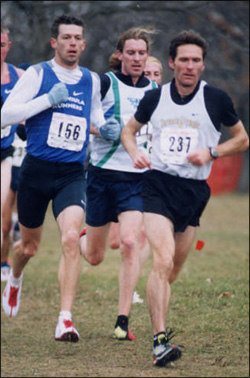
Steve Boyd leads Graham Hood
I started training year round at age 16, which is just after I gave up my dream of playing in the NHL (I was 1.75m and 63kg, fat chance!). I was a pretty solid junior 800/1500 runner, but nothing really special (1:54/3:53). I stayed in Canada for university, where I was a standout in cross country and road racing, running 29:14 for 10k a few months after my 19th birthday.
What would a typical week consist of 15 years ago and what is a typical week now?
My total training volume isn’t much different now than it was 15 years ago, about 110-120kms per week, with two hard sessions per week (usually a tempo session of 30-40 mins. and a conventional interval session), although I take the occasional day off now, which is something I rarely did as an open runner. From age 17 to 38, I averaged only 1 day off in
40 . I’ve also been using the principles outlined in the Jack Daniels books, which is something I’ve been doing since about 1998.
What time do you believe you can post over 10 and 21K?
This is a tricky question, since, as I say, good performance seems to be a moving target these days. There are days when I’m sure I can run well under 30mins for 10k and 1:05 for 21k and others when I really feel my age (lots of back and stiffness and pain in particular). Getting the right training mix is very difficult when you’re over 40. There are times when training hard just seems to make me tired and not fitter, and other times where my body really responds to hard work the way it used to. My goals are certainly to run sub-30 and sub-1:05, but it wouldn’t surprise me in the least if I never ran under 30:30 and 1:06 again. My body is, in some ways, a complete mystery to me now as far as performance goes.
Any plans for a marathon?
No! When I trained for and ran a marathon back in 2000, I think I added 5 years to my body in 3 months! I developed a back problem after that that I’ve never been able to fully resolve. I only tried the marathon in the first place because, for a number of reasons, I thought it was my best shot at making our Olympic team. I think trying the marathon was the right thing to do at the time, but I have no desire to try again, especially with a 41 year old body!
What keeps you motivated to run?
As I said, my inability to live without the daily struggle of training to race! I guess I just love the excitement, and the trials, of racing; I just love the feeling of running hard and competing and I can’t seem to let it all go, no matter how much easier it might make the rest of my life, and no matter how much slower I get.
What do you believe is your secret to running?
That I genuinely love everything about it, which is not to say I don’t find it frustrating sometimes; in fact, it’s precisely because it’s frustrating and difficult that I love it. When things go well in running, such as when you run a fast time, compete well, or even execute a workout properly, there’s a great feeling of accomplishment, because you’re always aware of how easy it is to screw-up! The love of hard running is definitely an acquired taste, but once you have it will sustain you for a long time. If there’s one thing I’ve tried to pass on to the athletes that I coach it this: in the end, no matter what, you have to learn to love what you’re doing; to revel even in the really difficult stuff, if you want to stay with it, and, to improve, you have to stay with it for the long haul.
Steve Boyd’s on-line training site, http://www.physi-kultrunning.com/