




 Paul Grech profiles Malta’s Giselle Camilleri
There is one fundamental difference between a person who is successful and someone who fails to reach his potential: determination.
This applies to atheltics just as much as it does to everday life. Two years ago, Giselle Camilleri was on the verge of quiting athletics. The disappointment of having to miss the Small Nations Games held in San Marino was simply too much.
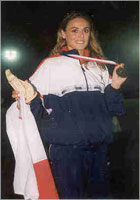
It was at that point that she dug out the determination that is typical among winners. Instead of giving up, she decided to give it another go and began training once again. And she received her reward in June of this year when she managed to clinch a bronze medal in the 10,000m of the Small Nations’ Games held in Malta.
“Let me go back two years,” she explained. “In 2001 I had achieved the qualifying time for San Marino but a couple of months before the event I my shin started hurting me. I kept trying to keep it at the back of my mind. But with only a month to go I couldn’t continue and collapsed during training. I ended up doing more damage because I couldn’t run for four months.” This injury was the start of her problems. “I started gaining weight and the more depressed I felt, the more I ate. It was a viscous cycle and I couldn’t find the strength to start training. I used to feel embarassed to go out running because I was so out of shape. Then I slowly started doing some light training. Last August I thought that there were only a few months to go to the Small Nations Games and decided to focus exclusively on them.”
“I very much believed that with God’s help, everything is possible. Spiritually I was very calm.”
Indeed, her faith was a key element in her success at the Small Nations’ Games, along with the inspiring attitude of her coach Ivan Rozhnov. “Ivan is the kind of person that never allows you to lose confidence in yourself. On the contrary, he is always willing to gives you advice and he believes in patience and determination. Emotional stability is very important for a person who wants to be succesful in sport. He calmed me down. Three days before the race, I was so excited that I couldn’t sleep. Minutes before the race he helped me prepare for it mentally, so much that I went in it full of confidence and without any fear. I kept contact with Ivan during the race and he helped keep me positive and confident.”
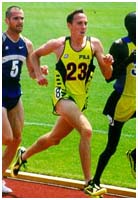
Camilleri on trackRegardless, she wasn’t among the favourites. Nor was she expecting any success. “No, I wasn’t expecting anything. There were foru athletes whose personal best is much better than mine.” But that is where the determination kicked in. “You can never say what is going to happen during a race. When you’re at the starting line, everyone is on the same level. You have to put everything into it and that is what I was determined to do.” And that is what she did.
With Carol Galea, one of the favourites, pulling out early during the race Malta’s hopes for a medal looked over especialy as Giselle started falling bhing. In long distance events, however, the most important thing isn’t how fast you can run but whether you can keep a constant pace for the whole race. Giselle’s finishing time wasn’t particularly impressive, but it was enough for her to take bronze.
“When I saw the San Marino athlete slowing down…I said that I’m going for a medal no matter what it takes. To be honest, the last kilmetre went by very slowly. I was so taken in by the atmosphere and the cheering that I couldn’t run any faster. I never imagined that there could be so much support whilst running at home. The stands were full of people and everyone was shouting their head off. After the race, I couldn’t stop thanking people.”
It was an emotional moment for her, especially when she ran towards her family and was welcomed with a shower of kisses and hugs. For Giselle, this was particularly significant.
“Unfortunately, when I was growing up I didn’t get along with my parents. I didn’t understand them and they didn’t understand me. Things got to a point that I had to leave home when I was twenty three [in Malta, people normally leave home only when they get married]. I know that deep down they were proud that I ws so good in sport and that I was representing my country but they never gave me any backing. Perhaps they didn’t agree with my style of life and I have to admit that perhaps they were right.”
In time, attitudes started to change. “They started getting more interested and started coming to see me run. For me the fact that they came and prepared a banner for the Small Nations Games was very important. I don’t think that they expected me to win a medal. At that point I think that they were very proud. A week after the Games we went to eat out to celebrate my mother’s birthday and they surprised me with a cake. I almost burst out crying in the middle of the restaurant. I didn’t think that they would appreciate it so much.”
“I thank God because this medal has helped bring me closer to my family.”