





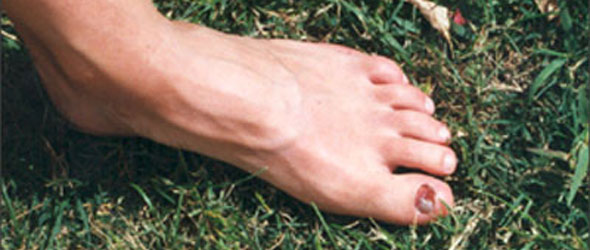
Footcare – Summer toe
When Autumn comes around, one thing I am usually quite thankful for is to be able to revert to closed shoes and not have to worry about my unsightly feet. Ironically, in the winter my feet, and more especially my toenails recover and are usually in good shape. Then when it is time to dig out the sandals again, I seem to be afflicted with another big toenail infection, with the result being that I have to sport toes with no nails or nails in various stages of regrowth for the entire summer months. Let’s face it running and pretty feet are not compatible. For women this is more of a problem when tempted by those tempting strappy sandals, the effect is quite obliterated by the ugly toenails. Over the years, I have learned some tips on how to doctor my own feet and cover up unsightly nails.
Toenails really are the ugliest bit of a runners’ anatomy, they become thick and horny, yellow or black. However, they play a very important role in protecting our toes and without them you sure know about it. The first rule with toenails is to keep them as short as possible, but without cutting them too low so that they hurt. You also need to cut them round and not square across if you are prone to ingrown nails, which then causes infection. If your nails are too long, you can either get a progressively black toenail, or worse still an infection will set in underneath the nail. In both scenarios you will lose the toenail. An infection is evident when the toe becomes swollen, red and very tender and typically throbs. The first thing you have to do is get rid of the infection and sometimes blister fluid that has built up under the nail. The most effective way to do this is to bathe your foot in a very warm water solution doused with domestic bleach or Betadine. You then need to take a thick needle which you have disinfected and insert it gently under the nail where the infection appears to be most concentrated. When you have released the pressure in the correct spot a lot of watery liquid, blood and some pus will come out from under the nail. Continue to soak the foot in the antiseptic solution after you have performed this little operation. You might have to repeat the process 2-3 times a day for a few days. Once the infection is gone the nail will be loosened and you may slowly begin by cutting it away from the skin.
This process may seem like pure torture, but at this stage the pain will have disappeared. Your exposed toe with no nail might be a little tender for a day or two, but quickly some hardened skin forms a protection over the nail bed area. Some runners prefer to hang onto their nail as protection for as long as possible. I have found that if you keep your old nail then the new one has difficulty to grow, and often the nail growth is stunted regrows funny ridges because the old nail is hampering growth. The result is that you are left without a new nail for even longer. The growth of a new big toenail can be anything from 3 to 6 months. What I have found is a good tip for covering up, is at first to stick a plaster over the toe when it is still very raw looking. Then with dark nail varnish colours you can paint a trompe- l’oeil effect to cover up, which can be very effective. If you are experiencing recurrent black toenails or infections, be sure to inspect the toebox of your shoes and make sure that the surface covering your toenails is of supple material and ample enough to not cause any compression. I have had the misfortune of a favourite model of shoe being updated with an added hard plastic flashy band to be culprit of toenail miseries. If you have recently bought your shoes, instead of throwing them away you can cut away any offending bit or make a slit in the toebox to relieve pressure on the toenails.
Running also hardens the skin of your feet and you might find you have lots of rough skin and ridges forming around the toes and on the sides of your feet. There are many different kinds of kits available in pharmacies from pumice stones to sophisticated foot graters. What I have found to be the most effective, is first to bathe the foot in very hot water for ten minutes and then with a blunt throwaway razor to gently razor away the skin build-up. If you develop a callus in one particular spot, it may be due to excessive friction caused by your shoes and you may have to consider a different model.
Athlete’s foot is a fungus infection of the skin that most often occurs in between toes, typically cracks occur between the toes, sometimes accompanied with a white scale. The main symptoms include dry and itchy lesions. To treat athlete’s foot you should ask your local pharmacist for an anti-fungal powder or cream treatment. As with warts this fungus thrives on warm moist conditions and sweaty feet and can be pick
ed up from walking barefoot in public places.
A tiny little wart on your foot if not seen to, can mushroom within a very short space of time and become very large painful. Warts are extremely contagious and can be picked up from public swimming pools, public changing rooms etc. They thrive in moist places. Unfortunately most remedies that can be purchased over the counter do not work, so if you suspect you have a wart consult a podiatrist without delay, as it can hamper or stop you from running.
Odour
To prevent bad foot odour, you should wear clean socks for each run. The most effective foot deodorant is ordinary old-fashioned talc, baby talc or other. It is not good to wash your shoes often, but every now place your shoes, with one mini dose of washing powder (cube or sachet) in each shoe, in a machine gentle cold water wash. Don’t dry them over a source of heat, but let them dry naturally.
Blisters
Blisters are a runner’s worst enemy, in a race they can stop you dead in your tracks. If you are prone to blisters it is desirable to do whatever is necessary to prevent them from occurring. Double sock layers can be every effective to prevent friction, but make sure you shoes are large enough to accommodate this. Try rubbing a very thin film of Vaseline on your feet before putting on your socks. If you are going to tackle a raid in the desert or sandy terrain, where blisters are unavoidable, then special pre-blister prevention steps may be necessary. Three weeks before departure you should start treating your feet daily by placing them in a canine paw hardening dip which is available from pharmacies. These dips cause your feet to turn a yellowy orange tint, but the benefits of the prevention outweigh the unsightly technicolour aspect. To alleviate blister pain quickly whilst running, you should pierce the blister and then place a blister plaster pad (Compeed type plaster) on the blister. Be warned though that these types of plasters actually merge with your skin and can then not be pulled off. Some runners swear by them, however, I prefer just piercing the blister and then putting plenty of eosine on the blister to allow it to dry out as quickly as possible. Keep blisters out of closed shoes and let them air as much as possible so that they dry out and heal quickly. Note that all eosine, Betadine, canine dip products will stain your socks and floors, so make sure you have an old pair of sandals or tongs handy.
Foot massage and foot baths
Nothing is more relaxing than a foot massage. If you can’t find a volunteer to massage your tired feet there are several self alternatives. There are many different foot massage gadget available that work wonders. You can get a simple wooden rod with ridges, or a ball with protrusions, that work as you roll these objects back and forth under your foot. There are also several kinds of shoe insoles and sandals that massage your feet and relax them whilst you walk which are good to put on after long runs. An alternative to massage is to treat your feet to a foot spa bath, if you don’t have an authentic version, you can fabricate one just using a basin with warm water and a foot product. There is a large choice of such products today in pharmacies and natural product stores and from Body Shop outlets. Effervescent products will give a massage effect. Walking on sand in the sea also has a beneficial soothing effect on your feet.
Further Articles by Cassandra under the Women’s section covering :
- No Sweat .. Those Sticky Sweaty Problems
- Periods – Running Red Days
- The run-down on sports bras
- Women only events
- Paula’s pit stop
- Tokyo on a Trot
- The doggone Olympic marathon road
- Running with poles
- Tokyo on a Trot 2
- Footcare for the Woman runner
- Mauritanienne 200 Race Report
- Shoe Generation Gap
- Motivation
- Maintaining motivation
- Security on the run