






 With great pleasure Time-to-Run nominates the great Australian marathoner Derek Clayton, who was to establish 2 new world records during his career.
What can be said about a man who was not considered to be built like a runner or who did not possess a sufficiently high VO’2 Max, but yet went on to set a new world record/best in the most endurance based running event?
The marathon certainly produces the athletes who dispel all theories regarding to what an athlete can or cannot achieve. Derek Clayton is one of those athletes. The ‘great’ Australian possessed a manner focused around the ‘sole’ purpose of achieving results ‘purely’ for himself.
His training regime was exhaustive, he was quoted as running 160 miles per week and the times he produced were phenomenal. He became the first athlete to break the 2Hr 10 barrier, as well as the first athlete to break 2Hr 09. Thus, achieving his remarkable place in history. There was doubt on his 2:08:33 performance, the usual ‘grumblings’ regarding a short course followed his astonishing performance in Antwerp in 1969. To compound matters even further was that this record was to stand for more than 12 years [ till 1981 ]
For our purposes we shall now attempt to plot the career of Derek Clayton, who is considered, in some circles, as the best marathoner Australia has ever produced. [ However, Rob De Castella may have something to say about that ]
Clayton was Lancashire born, Northern Irish raised and Australian finished. He was considered to combine all the bad qualities of all those particular cultures. And throughout his career he never did anything to dispel what people thought of him. The enigmatic and relatively large (6’2″, 160 pounds) would go on to become one of the world’s most ferocious racers over the marathon distance ever.
He was completely self-trained and averaged 140 to 170 miles a week, and sometimes ran over 200 miles a week. Unfortunately, his stubborn attitude towards his relentless training lead to numerous injuries, which in turn also endured him to many operations. He was also known to have exerted himself to such an extent during the achievement of his marathon world record in the ‘60s that his urine was black for a week [ bloody urine ] To say Clayton suffered from injuries is an understatement. During 12 years of sensational performances, he underwent 7 major surgeries, 4 to his Achilles tendons, 2 to each knee, and one on his heel.
Derek Clayton is the only man in the last four decades to break his own marathon world record. [ Until Khannouchi’s London 2002 performance ] Bettering his previous best by more than 8 minutes, he clocked 2:09:36 in Fukuoka for the world record in 1967, he then went on to run 2:08:33 in Antwerp, Belgium, in ’69. The latter record endured for more than 12 years.
“Through miles and miles of training, I honed my leg action to such a degree that I barely lifted my leg off the ground.” – Derek Clayton
His Championship pedigree was nothing to get excited about. He was 7th in the 1968 Olympics at altitude in Mexico and 13th in the 1972 Olympic Games in Munich. He did not fare well in the British Commonwealth Games either; he dropped out of the race at both the 1970 and 1974 Games. Clayton will mostly be remembered for his sensational, barrier breaking, world records during the 60’s.
He will also be remembered for the manner in which he attained/pursued these records. In 1967 at the Fukuoka Marathon in Japan, Clayton entered the event with a personal best [PB] of ‘only’ 2:18:28, whereas his opponents had PB’s almost 5 minutes faster. This did not deter Clayton matching the legendary New Zealander, Mike Ryan, stride for stride through the first 5km in 15:06. Ryan had always planned on going out at such a pace, however he had not banked on having his Australian neighbour alongside him. They continued this relentless pace covering 10Km in 29:57 and 15Km in 44:57. Approaching 20Km the wind turned against the runners and the immense frame of Clayton edged ahead. Clayton was alone at the 20Km split of 59:59, this first occasion the 1Hr mark was ‘dipped’ during a marathon. 21Km passed in 63:22 and amazingly the Japanese runner Sei-ichiro Sasaki was closing the gap on the front running Aussie.
The two were side by side by 30Km, passing through in 1:30:32. The two athletes were like the long and short of running, with Clayton at 188cm and Sasaki at 166cm. All the betting money was against the taller athlete, after all how could a man of such bulk be able to match his smaller opponent? Amazingly the two athletes began to exchange surges in the hope of testing one another. At 34Km Sasaki experienced the onset of side stitches and Clayton seized his opportunity to draw ahead. Sasaki was now a spent force and Clayton’s pace began to diminish, running 16:05 for the 5Km split from 35 to 40Km. At 40Km his time read 2:02:16 and the chance of the first sub 2Hr 10 was still a distinct possibility. As history records he achieved this by establishing a new World Record of 2:09:36, bettering the previous record by almost 3 minutes, which had stood at 2:12:25. The Japanese runner, Sasaki, held on to record the 2nd fastest time in history by finishing in 2:11:17. Clayton was now on top of the world and has been recorded as saying that “this was the most memorable event of my life”. Amazingly this was his 5th marathon and the first occasion that he had raced outside of Australia.
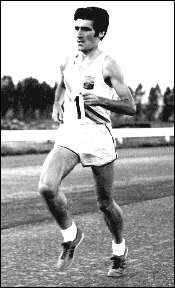
Derek Clayton
The following year, 1968, Clayton went on to finish 7th at the Olympic games with a time of 2:27:23. And because of the injuries he had begun to accumulate he was considered a spent force. He has also been quoted [in hindsight] as saying ‘If I had my competitive career to run over again, I would change some of my attitudes to injuries. I would show them more respect. Because, after all, injuries weren’t some unknown barrier I was trying to break through. Injuries were simply my body telling me that something wrong was happening‘.
Then in 1969 Clayton appeared at the Antwerp Marathon, where he would again shock the world with yet another brutal display of front running, as well as ‘ruffling a few feathers‘ before the event. Clayton had come to conquer all before him and wanted to put the world record ‘out of sight’. His ‘charming’ personality did not endure to his opponents.
Take note of the conversation recorded between those who were to compete against him. Clayton was talking to the Irishman Hogan and Englishman Alder and he stated: “I’m glad you guys are here because I’m going to smash you into the ground. I think I can run a world record. I’ve just come from Ankara in Turkey where I ran 2.17 and it was a breeze and I think I can go under 2.10.” Alder said: “I don’t give a damn about world records. I would rather win the Olympic gold even if I ran 2.30. I reckon that nobody remembers who holds world records. Everybody forgets them almost as soon as they’re made.” Clayton said: “We’ll I’m going to run the world record anyway and I bet you’re wrong. People will remember my world record. You won the Commonwealth Games but they won’t remember you. They’ll remember my world record.”
On race day, the Canadian Robert Moore set off at a suicidal pace passing through 10Km in 29:25. Clayton was soon to pass Moore as he set off on his relentless solo run to achieve his objective. The objective being the establishment of a world record which would stand till 1981.
In 1970 Clayton was to race the Traralgon Harriers Marathon in Australia setting a course record of 2.13.39 which still stands today, with no athlete coming within 10 minutes of the course record since.
Unfortunately, Clayton was never to race at the high standards of the late 60’s, however he will always be remembered, even though he was never to capture a major championship medal.
Even with the limited amount of marathons Derek Clayton scored points for, he is still able to score 110 points and achieves the standards needed to get into ‘the rankings‘ as well as to be placed in the ‘Hall of Fame‘. Result = Passed Congratulations
A special thanks to Derek Clayton who kindly donated the photograph.


La celebración de los Juegos de la Commonwealth, los Juegos Olímpicos en Melbourne, Australia en el año de 1956 La aportación de los atletas de Australia y Nueva Zelanda, contribuyeron a la mejora de las marcas en las carreras de medio fondo, fondo y gran fondo en todo el mundo atlético.
Las aportaciones técnicas del Entrenador de Nueva Zelanda, Arthur Lydiard con marcas mundiales y medallas olímpicas. Los resultados mundiales con atletas de Australia del Entrenador, Franz Stampfl. Los experimentos y resultados técnicos de los deportistas de élite, Ron Clarke y Dereck Clayton, con altas cargas de entrenamientos maratonianos, evolucionaron los medios de entrenamientos y los altos resultados deportivos que todavía practican e impactan a los atletas de los cinco continentes. Buenas noches.