






The marathon has a proud history and is steeped in tradition. History records that in 490 B.C., the soldier Pheidippides, covered the distance from a battlefield near 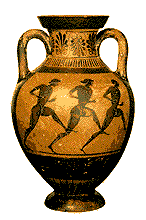 Marathon, Greece, to Athens in order to bring the news of a Greek victory over the Persians. At the end of this historical run he collapsed and died from the exertions of fulfilling his duty.
In 1896 at the inauguration of the Olympic games the legend of the soldier was honoured with a race from Marathon Bridge to the Olympic stadium in Athens. The run was the final event of the games and with the Greeks, being the hosts and yet to win a medal, they pinned all their
hopes on the marathon.
Twenty-five runners lined up on that day, April 10th 1886, upon Marathon Bridge. The Greek, Spiridon Louis a postal worker from the village of Marusi, did not disappoint the enthusiastic crowd waiting at the Panathenaic Stadium when he won the 24.85 mile (40,000m) in a time of 2 hours 58min 50sec (7:11 mile pace). He finished 7 minutes before the next competitor, with 8 of 9 finishers being Greek the country went into wild celebrations.
The marathon as an event was born. The following year on April 18th, saw the first running of the, now famous, Boston Athletic Association marathon. The date
chosen was to commemorate the famous ride of Paul Revere, remarkably similar in distance to the Marathon course as well as the fact that he also carried a message. The 24.7 mile course was from Metcalfe’s Mill in Ashland, Mass to Boston’s Irvingston St. Oval and was completed by 8 of the fifteen starters, with John J. Mc Dermott winning in a time of 2hrs 55min 10sec (7:05 mile pace).
Marathon distance becomes 26.2 miles
For the 1908 London Olympic games marathon the distance was changed to 26 miles so that the event could finish in front of the royal box. It took another 16 years before the distance of 26.2 miles was introduced, with the 1924 Paris Olympics being the first to hold the now official marathon distance.
Since those days the marathon has progressed into a dash for the line by the elite athletes with the time taken to complete the distance continually tumbling.