




Lara Gerada
That 2003 was a fine year for Maltese athletics is evidenced by the honours handed out to local athletes at the Sportivi Nazzjonali contest and the Malta Olympic Committee awards. Yet, the most central achievement came far away from the track and has hardly been given any attention.
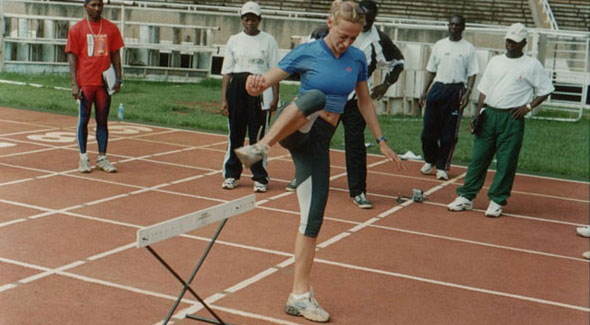
On two separate occasions, during the tail end of last year, three coaches based in Malta – Zeljko Aras, Lara Gerada and Ralph Mifsud – took part in a course leading to the IAAF Level II Certificate.
This course, in Kenya, is the highest existing level attainable. It leads coaches to prepare athletes for Olympic glory. Our total of such coaches is now four since Leandros Calleja had achieved this Level some time back. For us, this is an important accomplishment.
“For a small organisation like ours having four Level II coaches is no mean feat,” said Malta Amateur Athletics Association (MAAA) president Tony Chircop.
“Up to a few years ago we only had a few amateur coaches and as an association we did not even have a coaching structure. The MAAA was not doing much to encourage coaches.”
Gerada’s situation is typical of many coaches. Currently the leading triple jumper in Malta and a bronze medal winner at last year’s GSSE, she is eager to start giving something back to local athletics.
“I’ve been training for many years but now I’m asking how much longer I can go on and simply training myself,” she said.
“I wanted to find a way to stay in athletics once I’ve finished competing.”
Coaching offered the ideal solution and it is what eventually led to her “very pleasant experience” in Kenya. Mifsud agrees.
“It was great, fantastic,” he said.
“We were full-time students for two weeks with lectures starting at 9 a.m. till 5 p.m. Meeting coaches who have experience in middle or long distances – and Africa being a stronghold here – made the course even more interesting.”
This opportunity to exchange ideas with others also appealed to Gerada.
“There were many others whose culture is different from ours,” she said.
“Other than that, most of them were experienced and lead some very good athletes. Therefore, I could share ideas with them and that was the most important thing. It wasn’t just a normal course but I had a lot of time to discuss things with them.”
For Mifsud, the course was “perfect to charge you with energy to come back and coach”.
“Although a good set-up is required, the most important is adequate coaching and a lot of hard work,” said Mifsud.
“Now we have a few qualified coaches who can really do their job well. Obviously, we need good coaching at all levels.
“As far as young athletes are concerned, the local clubs are basically doing all the work. Schools could help here.”
Search for talent
Aras takes up the discussion.
“We often think that since Malta is a small country we don’t have what is needed for athletes to be successful. That is not the case,” he said.
“Malta’s real problem is that of attracting people. That is the biggest challenge: finding talent. I’m sure we could create something special.”
Now it is up to the MAAA to fully utilise these coaches’ new-found expertise.
“We are working on a coaching scheme where we intend to employ four foreign experts for short periods,” Chircop said.
“The Maltese coaches will be assigned as understudies at first. Eventually, they will be employed on part-time basis as “event coaches” and hopefully continue to build our coaches structure.
“We would like to have this ‘event coaches’ scheme in place within a few months,” he said of the scheme that should fill the void created by the departure last year of national coach Geoff Ward.
With the idea of holding another Level I course to attract new coaches also in the pipeline, it is clear that there is the belief that athletics’ success away from the track is the best way to guarantee future success on it.
Taken from The Times of Malta (www.timesofmalta.com)