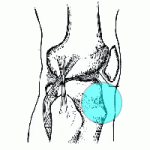






Injuries to the hamstrings are the most common soft tissue injuries to the thigh. Symptoms of a hamstring strain include pain, muscle spasm, swelling, and inhibition of movement.
Treatment of acute hamstring injury
- stop running, especially in the case of severe pain
- if pain is mild, then reduce training load and intensity, and avoid running on cambered surfaces
- take a course (5 – 7 days) of non-steroidal anti-inflammatory drugs (ibuprofen/voltaren/cataflam/mobic) available from your general practitioner or pharmacist
- apply ice to the hamstrings – for 10 minutes every 2 hours, in order to reduce the inflammation
- self-massage, using arnica oil or an anti-inflammatory gel, to the hamstrings
- stretching of the hamstrings.
It is important to stretch both the top and bottom of the hamstrings.
1) Lying on back. Pull leg to chest with hands under the knee. Keep your leg as close to your chest as possible, and straighten your knee as much as possible. 2) Lying on back, wrap a towel around your foot. Straighten your knee and use the towel to raise your leg and to pull your toes up towards you. Hold each stretch for 30 sec. Relax slowly. Repeat to opposite side. Repeat stretch two – three times per day. Remember to stretch well before running
- return to running gradually
- full recovery is usually between three to six weeks
Medical treatment
- physiotherapy. Soft tissue massage, dry needling (acupuncture), and electrotherapy modalities will speed up the rate of recovery from a hamstring injury. Progressive stretching and strengthening of the hamstrings will enhance the recovery process
- orthotist or podiatrist for custom-made orthotics to control overpronation
- in the case of severe strains, surgery is usually not indicated. The use of crutches, as well as a supportive brace may be necessary for pain relief
Alternative exercises
- swimming
- pool running
- cycling (in low gear)
Preventative measures
- stretching of the ITB, quadriceps, hamstring, and gluteal muscles. Hold each stretch for 30 seconds, relax slowly. Repeat stretches two – three times per day. Remember to stretch well before running. Remember good flexibility must be obtained before effective strengthening can occur
- strengthening of the hamstrings
- correction of muscle imbalances (quadriceps:hamstrings ratio)
- strengthening of the “stabilisers” (the transversus abdominus, rectus abdominus, gluteal and adductor (groin) muscles
- correct shoes, specifically motion-control shoes and orthotics to correct overpronation
- avoid cambered roads (stay on the flattest part of the road)
- gradually progression of training programme
- incorporate rest into training programme
Other factors
Recurrent hamstring injuries may also develop after a number of removed causes. These causes may include:
- referral of pain from the lumbar spine. This may occur due to disc bulges at the L4/5 or L5/S1 levels, or due to joint stiffness of the lumbar spine or sacro-iliac joints, which may result in nerve root irritation. The irritation of the nerves may cause local muscle pain, spasm or a more prolonged, generalised increase in tension of the hamstrings. Local treatment of the lumbar spine and sacro-iliac joints is necessary
- meniscal (cartilage) problems at the knee. The hamstrings work to stabilise the knee joint during the running cycle. An alteration in the biomechanics of the knee joint due to meniscal tears or degeneration may lead to excessive loading of the hamstrings, and recurrent injury. Restoration of full knee function is required to avoid recurrent strains of the hamstrings
- adhesions (tightness) of neural tissue. The loss of mobility and subsequent increased sensitivity of neural tissue (particularly the lumbo-sacral nerve roots) may predispose runners to recurrent hamstring strains. This is especially relevant when sprinting or changing pace. Mobilisation of the neural tissues by a physiotherapist and stretches are indicated to reduce the incidence of neural tension
- postural variations. An increased lumbar lordosis (curvature of the lumbar spine) causes an increase in the resting tension of the hamstrings. This results in the hamstrings being functionally tighter, and more inclined to fatigue early. Postural abnormalities should be addressed through the correction of muscle imbalances by stretching and strengthening
- poor running style. As mentioned previously, the hamstrings work strongly throughout the running cycle. A running style which is poorly co-ordinated may result in early fatigue, and injury. An altered stride pattern may be necessary. Over-striding should be corrected, especially when running uphill/downhill
- loss of the normal quadriceps/hamstring ratio. Excessive quadriceps development may produce an abnormal force in the hamstrings, particularly when there is a loss of co-ordination due to fatigue. This is more of a problem in athletes who mix cycling with running (e.g. triathletes). Cycling results in increased quadriceps development which may predispose the athlete to hamstring injuries, particularly when running. There may also be a pre-existing weakness of the hamstrings. The imbalance in the ratio of strength between the quadriceps and hamstrings must be corrected to avoid recurrent injury. Isokinetic strength testing and an effective rehabilitation programme are essential
Isokinetic testing
Isokinetic strength testing is widely used as an indicator of recovery following muscle injuries. The testing is performed using a machine known as an isokinetic dynamometer. This equipment is available at the Sports Science Institute of South Africa, and at biokinetics practices around South Africa. The machine allows the hamstrings to be tested through the full range of knee movement, and concentric, eccentric, and isometric (static) strength in assessed. The muscle endurance of the hamstrings may be assessed, which together with the eccentric strength and the quadriceps/hamstring ratio, is particularly relevant for runners. Isokinetic testing allows for specific weakness to be identified. This will allow for an individual strengthening programme to be drawn up to treat your specific problems, and will assist in effective rehabilitation.
Finally, once all the various factors have been identified and you have completed the rehabilitation process, remember to get back onto the road slowly and steadily. And remain injury-free!
View the articles relating to the hamstring:
View: Injury guide – Sites of the Most Common Running Injuries