





 Doctor Andrew Bosch, based in Cape Town, South Africa, ran the London to Brighton in 2004. Andrew has his own section with Time-to-Run named TheABC – The Andrew Bosch Corner, Sports and Exercise Science.
London to Brighton Ultra 2004: My physiological perspective By Andrew Bosch – TheABC
The London to Brighton ultra marathon has a long history, with the first recorded race between the two cities, a distance of some 88km, taking place in 1837. This makes the London to Brighton a race with a history spanning 165 years.

London to Brighton
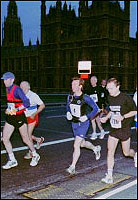
The race starts at Big Ben in London, with the starting “gun” being the first chime of 7 AM. With a time limit of 9 hrs 50 minutes, this is not a race for those who wish to walk, jog and drag themselves to the finish of an ultra. Rather, I would describe it as a race for a well-trained ultra runner, be that a fast runner, or one who is racing the cut-off time.
The streets of London at the start time of 7AM are busier than one might expect, but then this is London and maybe the streets are never deserted. Nevertheless, traffic was not a major problem as the race field made its way through the streets of London towards Brixton and on to Croyden at around 15 miles (24 km).
The weather forecast for race day was for rain, but although very cold, it was not raining during those first 15 miles. There was still no sign of rain as 20 miles (32 km) at Redhill was passed. But at some time on the way to Crawley at 30 miles (50 km) that changed, and the rain that had been forecast started. Somewhat gently at first, but then very heavily, made all the worse by a strong head wind. Given that an ultra distance race is run rather slowly in absolute terms, not much heat is generated, compared to that being lost under these severe conditions. Thus, rather than physiological problems related to heat, such as a rise in core temperature, runners were now faced with the opposite problem of greater heat loss than heat production. Such a situation can lead to hypothermia, which is a drop in core temperature. Potentially this is a more severe health problem in an ultra race than over-heating, which seldom occurs in long distance races (despite popular belief) and is a greater threat in shorter races such as the 10 km, which is run at a much higher intensity and therefore much higher metabolic rate. But back to the race. Most runners donned some form of wind or rain-gear for protection. Goggles would have been great!
In 2002, I went into the London to Brighton with a persistent hamstring injury. This particularly injury had proven remarkably resilient to all forms of treatment. Normally, a chronic hamstring tear responds well to treatment by physiotherapy such as cross friction, to application of ice, and to stretching. However, in this case, despite such treatment, as well as a strengthening regimen that included eccentric training and brief periods of anti-inflammatory drugs, the hamstring had not recover fully before the race and I was forced to withdraw relatively early. Subsequently, I started a more concentrated and specialized eccentric training programme and it appears that this specialized rehabilitation has been successful as the hamstring has not been a problem for some time and it did not cause any problems in the race.
Instead of a hamstring problem, this year I suffered a problem much less severe, but nevertheless sufficient to affect my race performance. A blister. Something no runner should ever have to worry about these days with the high technology of shoes and a knife to cut holes in the front of a shoe if blood blisters under toe-nails is a problem. So why did I get this irritating problem? In the race we had to run in the same direction as the traffic, whereas in training I run facing the traffic so that I can see oncoming cars. I think the blister probably resulted due to the opposite nature of the camber. Although this may appear to be a small difference, it was sufficient to have an impact. Other problems due to the camber difference became apparent after the race, such as a sore knee that persisted for two weeks post race. Other runners were also complaining after the race of “unexpected” aches and pains that can be attributed to the camber. All this is a good practical example of why everything possible should be done in training to mimic race conditions as closely as possible. Whereas most times this relates to diet, and race day fluid and carbohydrate intake, it appears that this must be extended to include some training runs on the same side of the road as will be run on race day.
The seconding tables in the London to Brighton are stocked with each runners’ own drinks, supplied by the participants to the organisers before the start, and which are then taken to each table by the organisers. While this has huge advantages, on the down side, the tables are spaced at 5-mile (8 km) intervals, which is a bit sparse if a runner is to rely entirely on the seconding tables for fluid and carbohydrate intake. Ideally, one would want to ingest approximately 500 – 600 ml of fluid per hour. With the tables situated as they are, this means ingesting 300 ml of fluid at every table at 6 hour pace. Since only the race winner runs at that speed, it represents a problem for the slower runners who will be reaching a table at much more timely intervals. One way of overcoming this problem is to take two bottles and to run a short way with one of the bottles after quickly drinking the first.
Since I had a personal seconder and therefore not reliant on the tables, I was able to drink in a more optimal pattern. This consists of ingesting around 150-200 ml of fluid every 15-20 minutes. The drink consisted of a 10% glucose polymer solution which tends to not cause nausea or gastric distress which is often be a problem in long races. A combination of the polymer, with occasionally some “Coke” for variety, supplies adequate fluid and carbohydrate. Ideally a runner should ingest almost 1g of carbohydrate per minute and the regimen just described meets that requirement. It should not be necessary to ingest any solid food during long distance races. Obviously, there is no way to avoid the increasing fatigue due to the distance of the race, but optimal carbohydrate and fluid intake during long distance races can minimize the extent of that fatigue.
Long training runs over very hilly terrain to build leg strength meant that the long climb up Ditchling Beacon, although late in the race (about 75 km), was not a major problem, although I was very tired at this point of the race. Although tedious, the long training runs are the key to a successful ultra: Ultimately, training has to be specific so that the physiological adaptations that occur as a result of that training are appropriate for the race and goals that are being attempted. It is in this area that science can offer a lot to the art of coaching.
The climb up Ditchling Beacon was “interesting”. Wind-driven rain, road awash, cold, and visibility down to about 50m, highlighted how important the mental component of ultra running is. Interestingly, some of the latest ideas on fatigue are centering more and more on the brain involvement in fatigue, in a theory called “the central governor”. In this theory, we suggest that the brain computes how far and for how long a runner can continue at a certain speed before there is the risk of inducing some form of “damage” to the body. The computation is based on a huge number of inputs, including things such as prior experience, temperature, muscle and liver glycogen stores, altitude, etc. This is combined with sensory signals received from the muscles, tendons and pain receptors. Thus the runner is prevented from causing damage to the body. However, the best runners can probably over-ride this built-in protection mechanism to some extent and push just that little bit harder. Therefore, in the final 20 km or so of a race such as the London to Brighton the brain probably plays a major role in determining whether someone attains an optimal performance or not. Thus the running pace is pre-determined, and fatigue and subsequent slow-down occurs when the brain’s computed “end-point” is reached.
Although there is a long downhill of approximately 2 miles (3 km) to the finish, I was unable to use it to my advantage as by this time the blister was quite impressive in size and running downhill was very painful. At least my legs were not too sore as I had included some specific downhill running in my training. Anyone “racing” an ultra should include some downhill training to condition the thigh (quadriceps) muscles to withstand the increased eccentric component of muscle contraction that occurs during downhill running. This helps prevent the extremely painful thigh muscles so often experienced at the end of ultra marathons that can reduce speed to a painful jog. The “protective” effect of appropriate downhill training can last for many weeks. But protective training runs were far from my mind as I crossed the finish line in 7 th place.
The next day I was very stiff and sore from delayed onset muscle soreness. While most people think that post-race stiffness is due to lactic acid in the muscles, this is not the case. The soreness is actually the result of damage to the muscle fibres, with resultant oedema. There is not much that can be done to speed up this aspect of the recovery process, but there is some evidence that increased protein intake may be beneficial in the long term. Further research will establish whether this is, indeed, the case. For now, however, the best advice is to ingest protein and carbohydrate, and to rest. Start running only when the body has recovered from the post-race stiffness, and then at a greatly reduced load compared to normal.