







 This article is provided by Teri Burgess, resident Physiotherapist from Time-to-Run Cape Town, covering Recurrent Hamstring injuries. Teri is also the contributor of the hugely popular article, covering the 5 most common running injuries, aptly named The BIG Five.
Picture it… you’re gliding up your favourite long hill, breathing well, legs feeling strong. You reach the top, and happily you start running downhill. Everything is perfect: it is a beautiful morning, that hill has never felt easier, and you are even sweating less than usual. Suddenly it all changes in one simple step. You feel a sharp pulling pain in the back of your thigh, and you are reduced to a hobble – all the way home. While you do contemplate throwing your running shoes away, you are also puzzled. You can’t think of anything you have done incorrectly to cause this injury. You have been increasing your training gradually, without doing any major speed or hill sessions. You have even been stretching a bit, and certainly felt no niggling pain or stiffness in the muscle up until now. Then you remember that this hamstring gave you problems last year, and the year before, also without warning. 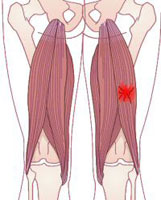 Sound familiar? Recurrent hamstring strains are one of the most common running injuries. We aim to explain why, how you can get back on the road as quickly as possible, and what you can do to remain injury-free. The running cycle When running, a stretch-shortening cycle of muscle action occurs, to allow for efficient movement. The hamstrings work strongly during the “swing” (when your foot is off the ground) phase of the running cycle. The hamstrings work eccentrically, to control the movement of the knee, and to store elastic energy in the muscle. When your foot strikes the ground in the “stance” phases of the running cycle, the hamstrings work concentrically with a release of stored energy. The hamstrings contract to stabilise the knee joint, to extend your hip and, with the quadriceps, absorb vertical forces of 3.5 – 4.5 times body weight through the stance leg. As the hamstrings are working throughout the running cycle, there are a number of mechanisms of injury that need to be considered in order to prevent the problem from recurring. View the articles relating to the hamstring:
View the articles under the Injury and Treatment section: View the articles :