






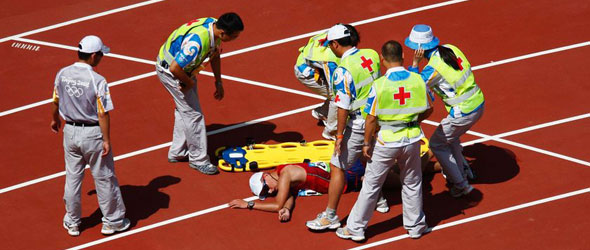
Historically, the understanding has been that runners collapse (often at the end of races) due to dehydration. This is popularly thought to be more likely when the environmental temperature is high and dehydration more severe. The term heat exhaustion has been used to describe a mild form of the condition, while heat stroke has been used to describe a more advanced stage of heat exhaustion.
Collapse in the heat by Doctor Andrew Bosch
There are a number of critical errors in the traditional thinking. Firstly, and possibly most importantly, rectal temperatures are not abnormally elevated in runners with “heat exhaustion”.
Secondly, there is no published evidence that runners with heat exhaustion will develop heat stroke if left untreated and thirdly, the question must be asked why these runners nearly always collapse at the finish of the race and not during the race. Thus we must look for another explanation as to why the runners collapse in this case. The explanation is found in a condition called postural hypotension.
While running, the high heart rate and rhythmic contraction of the leg muscles maintain blood pressure and aids in the return of blood from the legs. When running ceases, however, the pump action of the leg muscles stops and the heart rate drops rapidly. This results in pooling of the blood in the veins of the lower limb, which in turn causes blood pressure to decrease. The lowered blood pressure results in collapse.
Treatment is therefore very simple: If the runner lies down with the legs elevated, the return of blood from the legs is aided, blood pressure is restored and after a short while the runner will have recovered.
As a preventive measure, it is a good idea to continue to walk after the finish line has been crossed. In big races this is often not possible because of congestion at the finish, but ideally walking for a short while would be a good option rather than just standing immediately after stopping.
A second possibility is to lie down as soon as possibly and elevate the legs slightly. I have always followed a combination of these two. I walk for a short while (a few minutes) after finishing, then find a quiet spot to lie down with my legs raised. This has the added benefit of making the legs feel less “heavy” and tired.
Heat exhaustion does not, therefore, exist and is not a condition to be concerned about. This contrasts with heat stroke, in which the body temperature becomes very high and is a potentially dangerous state. Even after the athlete has stopped, either voluntarily or because of collapse, the temperature remains elevated because of physiological and biochemical abnormalities in the muscles. Thus the athlete must be cooled as quickly as possible to bring the body temperature down to below 38 degrees Celsius. This can be by fans or rubbing with ice, or any other available means to cool the athlete.
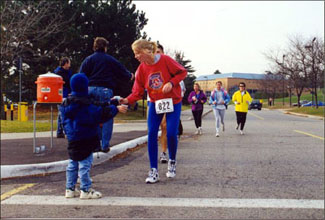 Heat stroke develops as a result of a combination of a number of factors. Firstly, a high environmental temperature is more likely to result in the problem than when conditions are cooler.
If the humidity is also high, there is an additional heat load on the runner because the sweating mechanism of the body is rendered ineffective. Sweat running off the body, as it does when the humidity is high, does not result in cooling.
To cool the surface temperature of the skin the sweat must evaporate. Secondly, and also very importantly, the heat produced by the runner must be high. Thus, it is the faster athletes who are at risk. It is also, therefore, in races shorter than the marathon in which there is a high likelihood of heat stroke because of the much higher running intensity in shorter races such as cross country (on a hot day) or a 10 km race.
Thirdly, it appears that some runners are more susceptible to the development of heat stroke than others. In this regard it mimics a medical condition called malignant hyperthermia, in which the body temperature rises unexpectedly during anesthesia.
Contrary to popular belief, dehydration is not a major cause of the development of heat stroke. A runner can develop heat stroke without being dehydrated. Conversely, a runner can be dehydrated but not develop heat stroke. If the recommended guidelines for fluid ingestion are followed (~600 ml/ hour), it is very unlikely that fluid deficit will play a role in the development of heat stroke.
View the articles:





Trackbacks/Pingbacks