





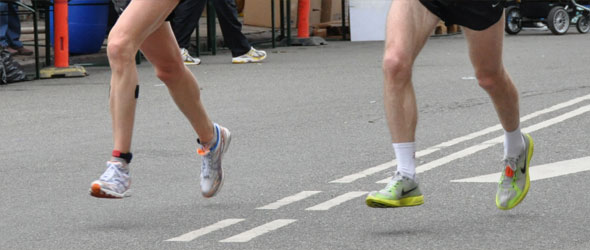
The sub 35 minute 10K program – this is the one of the big goals that runners’ set for themselves when they first move to being a more serious runner,the ambition of running sub 35 minutes for 10km.
sub 35 minute 10K Training Program
Firstly, what must be understood is that in order for you to run sub 35 minutes for 10Km, you must be able to run below 3 minutes 30 seconds per kilometer for the distance.
Introducing paced running to your program is the main secret to the success of running faster over the 10k distance. You will need to either have a track available or you will need to measure out a 2K training circuit (preferably a loop course).
What we are looking at to start with, is being able to run 5Km’s close to 3min 20sec per kilometer. It is a priority to get your 5K time down to sub 17min [16min 40sec = 3.20 per K]. Added into your training will be sessions at this speed as well.
Your components now consist of running at 10K pace, running at 5K pace and then add to this a long run of 75 to 90min [you can increase this run to 2Hrs if you have the intention of running 21K’s] and you are ready to progress towards your objective.
Now, the secret to your training should be to balance your training with your lifestyle. Your running must never become too much for you. You must always be able to do the sessions asked of you, if you miss a training session you can’t make it up. There is no going back to make up for what you have missed. Doing this is what normally leads to injuries.
Other 10k Training Programs available:
- sub 31 min 10k training program
- sub 33 min 10k Training Program
- sub 40 min 10k Training Program
- sub 45 min 10k Training Program
- sub 50 min 10k Training Program
- sub 55 min 10k Training Program
- sub 60 min 10k Training Program
10km Program Tips
Forums for our 10k Training Programs – Feedback and Advice
Training explanations and must do’s below schedule
| Training Program towards a sub 35 minute 10K | |
|---|---|
| Day | Session |
| 01 | 75 to 90min easy distance |
| 02 | 30min easy run |
| 03 | 5x2k R90 6min 50 (3.25 per k) T |
| 04 | Rest |
| 05 | longest run – ‘time on feet’ up to 1Hr 30min or 2hrs if 21k |
| 06 | easy day of 30min running |
| 07 | easy day of 10k running – relaxed |
| 08 | 6x1k R60 3min 15 to 3min20 L |
| 09 | easy day of 40min running |
| 10 | easy day of 1hr running or up to 15k distance |
| 11 | Rest |
| 12 | 5K paced run – aim sub 17:30 5k |
| 13 | 1hr easy run or up to 15k easy |
| 14 | easy day of 30min running |
| 15 | 10 x 400m R 60 400/76 to 78sec – no faster P |
| 16 | easy day of 10k running |
| 17 | 30min easy 6x1min fast with 1min slow – 1min @ Race Pace F |
| 18 | Rest |
| 19 | Race day up to 15K [21K if doing 2Hr long run] |
| * | easy recovery after race. 30 – 1hr |
| ** | 2nd easy day after race. 30min |
| *** | final easy run after race would be Day 01 of program |
Training explanations and must do’s :
T stands for 10K pace development L stands for 5K pace development R = Rest F is for Fartlek
Easy running is important for recovery and preparation before a harder day. Easy is at a pace where you are able to talk [“talk-test”] All quality sessions must be preceded with a warm up and stretching, and it is recommended that you warm down as well.
This is a 3 week cycle and after every 3 weeks you are able to run a race, up to 15K. It is not recommended that you use this program to race above 15k. If you have raced 21k’s before continue to do so, but increase your Long run to 25k if you have the intention of racing 21km. After your race day, it is imperative that you use the next 3 days as recovery.
The 5K paced run, you should not run faster than 16:40 on these days. If you want to run a hard 5K then you must do so on the race day. Adhere to this advice for success with the program.
sub 35 minutes for 10km is often quite elusive to runners, at Time-to-Run we help to make it a reality
After 2-3 months on this program, it is recommended that you take a break from this schedule. The break should be for 2-3 weeks and during this time you should take a break from running for 3-4 days and then come back to running by building up to distance runs without any quality sessions
[ The Off Training Period followed by The Build Up Period ]
Print out the program and fill in your comments and under ‘effort’ fill in your ‘perceived’ effort for each session. rate your effort from 1 to 5, with 5 the hardest and 1 the easiest. [This is NB] For Printable Program : Click here
Finally, this program is not recommended for a ‘beginner’ was has not got a background of running. It is recommended that you have a reasonable amount of ‘running’ without injury before attempting this program.
Further data has been added to the Training section about fartlek, ‘build-ups‘ and methods.
Author: Gavin Doyle
page updated: February 2026











Hi Ed,I’m a runner from the UK,the moment I’m in 35 mint shape,or perhaps a bit slower due to non any kind of running events due this times that affect us all.im writing to you to know your opinion about half marathon.i don’t know if any other fellow runners asked this before.could we adapt this schedules for
Half marathon?if so,I guess it’s to extend the long runs and tempo runs.could you please let us know your opinion and advice?thank you very much for your time and response.ah, almost forgot,my Pb on the half is 1h18.right before lock down,one year ago.not sure where am the moment.apologies for such long mail
Hi there, yes, this program has been used for the half-marathon. Simply increase your long run on the first weekend of the program to 18-20k, the rest of the program esepcially the 5 x 2k session sets you up sufficiently, enjoy TheEd
Hello. How can I improve running for 5x2k as I can do max 3 runs after I feel exhausted,legs won’t listen. Yesterday I did 5k run in 17:01. Is it to early for me to start 35 min for 10k. Also is there any food advisories? I think hunger is my weakness at the moment , I feel like teenager with huge matabolism in my 37 years body.
Hi Rami, run the 2000m at a slower pace until your body adapts to doing the 5 x 2k session. Even if you start off slowly, the secret to this session is completing 5. This is the one session that makes your racing 10k easier. TheEd